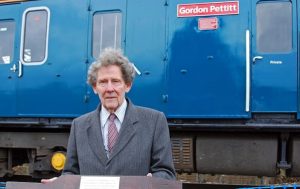
It is with deep sadness that we reflect on the passing of Gordon Pettitt — a pioneering figure in the railway industry, and one of the founding members of our Institution. Gordon wasn’t just a part of our beginnings; he was the spark that helped ignite the vision.
As the first President of the Institution of Railway Operators, Gordon played a vital role in shaping what would become the cornerstone for professional railway operations. He, alongside a group of passionate peers, recognised a growing need in the industry — not just for a community, but for a unifying body that would promote excellence, share knowledge, and uphold the highest standards in railway operations.
Gordon once said, “We always had a vision to have a national organisation.” That vision became reality thanks in no small part to his tireless dedication, his wisdom, and his unwavering belief in what could be achieved when like-minded professionals come together with purpose.
Through 1999, Gordon and the founding team worked with extraordinary commitment to lay the groundwork for what was officially launched in December of that year — the Institution of Railway Operators.
By Gordon Pettitt FIRO, Founding President of the Institution
March 2009
There had been a long-standing need for a professional organisation for those involved in railway operations but with the advent of privatisation the need became acute. The lack of such an organisation during BR days led to a widespread misunderstanding of the operational role by other departments and a shortage of men and women seeking a career in operations. The introduction of Sector Management in the 1980s and the subsequent introduction of the “Organising for Quality” in the early 1990s highlighted further a serious shortage of competent operators at middle and senior level.
At privatisation, responsibility for the operation of the railway was split between the infrastructure provider and the freight and passenger operators. It was now vital that those having or seeking a career in operations, regardless of whether they worked on the infrastructure side or in a train operating company, could belong to a single professional organisation covering all aspects of railway operations.
The IRO was therefore formed to take into account the needs of a new era. The governance arrangements required the Board to be formed of senior managers from all the constituent parts of the new industry structure including LUL and Light Rail. I am delighted that although membership of the Board has changed over the years, it continues to be made up of people at senior levels from all sections of the industry. This support at the highest level has been significant in fundraising but has also contributed to the increasing number of Corporate Members. In planning the IRO for the future, founding members were convinced that entry should be open to all operating staff at all points in within their career. There would be different levels of membership grades, but these would also be open to all, provided that the relevant qualification levels could be met by taking advantage of the courses to be provided by the Institution. I am delighted at what has been achieved so far. In particular the 21 Degrees and Diplomas awarded last year to the students who started courses in 2005 was a landmark in the short history of the IRO. But it is only the beginning of what I hope will become an ever-increasing number of students each year taking up the opportunity to improve their qualifications and increase their career opportunities. Currently no less than 138 students are at various stages of study in the IRO education programmes.
In a move not envisaged by the founding members, the introduction of the Young Professionals in 2006 was another landmark. I would like to congratulate all those involved with getting this project off the ground. The varied programs including a highly relevant continental visit should be of wide interest to younger members seeking to develop operational careers.
Looking ahead I see the need for an increasing number of qualified operators. I joined British railways in 1950 but during the whole of that time there has never been such a demand for increasing capacity on the network. Much of this capacity will be new infrastructure – Thames Link, Cross Rail, East London Line, HS2, Gauge enhancement for freight. These changes will need new and innovative operating rules and procedures for a variety of new systems such as ATO, ERTMS and the 7-day railway.
The leading operators of the future will be those who not only understand how to operate the railway today but be able to apply fundamental principles to introduce new practices and procedures that will meet the demands for new capacity at an affordable cost. This is the challenge of the IRO of the future.
